School Admissions Open in Jhansi: Questions Parents Should Ask Before Enrolling

Before you enrol your child at any Jhansi school this season, get past the brochure. Verify the board affiliation on CBSE's own portal, ask for the full fee structure up to Class 12, confirm the school follows RTE admission rules and weigh class size, safety, transport and the daily commute against your own child's routine.
Introduction
School admissions open in Jhansi every year with a familiar rush of banners and WhatsApp forwards and it is easy to pick a school on impulse. A city this size gives you fewer options than a metro, which makes each choice weigh more. This guide is a set of questions to ask before you sign anything: is the affiliation genuine, what the admission process really involves, what the fee structure adds up to over the years, how the teaching holds up and whether the campus, safety and commute suit your child. Ask these early and enrollment becomes a decision you control.
When Do School Admissions Open in Jhansi and How Early Should You Start?
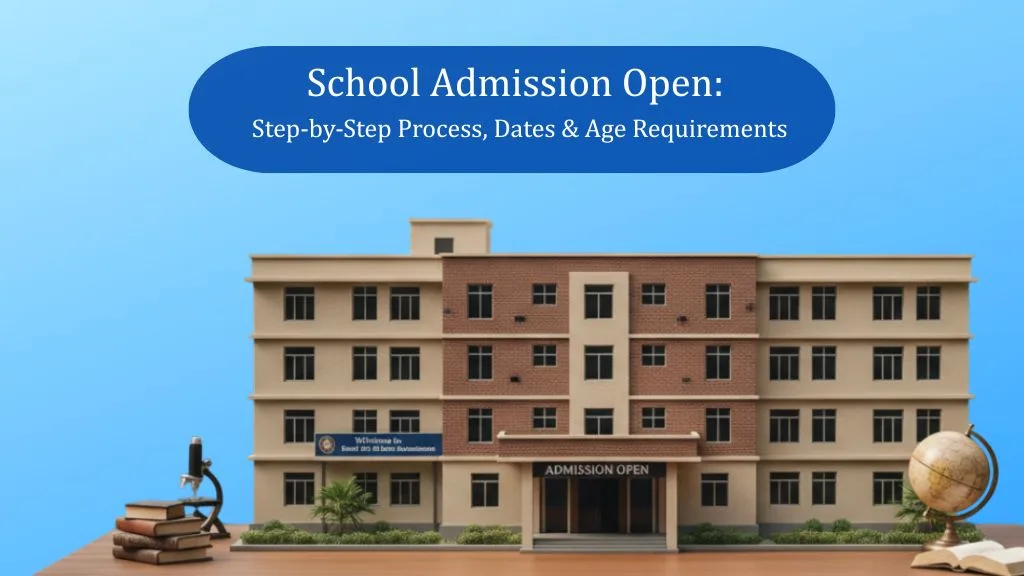
Most entry-level admissions open months before the April session, often through the winter and the sought-after schools fill first. Do not wait for the banner to go up. The district lists more than sixty CBSE-affiliated schools, so you have room to be selective if you begin early.
Entry classes such as nursery, KG and Class 1 usually open first and close fastest. Ask each shortlisted school for its exact window in writing.
Registration and formal admission are two different steps. Filling a registration form does not hold a seat for your child.
Get your documents ready before the window opens, so one missing paper does not cost you a place.
For a mid-stream class like Class 6 or 9, seats depend on vacancies, so enquire directly instead of assuming there is space.
The Kinds of Schools You Will Be Choosing Between in Jhansi
Jhansi's options fall into a few clear types and knowing them narrows the search quickly.
Central government schools such as Kendriya Vidyalaya, which follow fixed fees and their own admission-priority rules.
Cantonment-linked schools, including the Army Public School and the residential Sainik School, some of which carry eligibility conditions.
Private CBSE schools with international exposure
Older institutions on other boards, such as an ICSE one, worth a look if CBSE is not your only preference.
What Should You Ask to Confirm a School's Board and Affiliation?
Ask to see the affiliation certificate and the Mandatory Public Disclosure page, then verify the number yourself. A genuine CBSE school makes this simple.
CBSE rules require every affiliated school to run a website carrying its affiliation status, infrastructure, teacher names and qualifications, student numbers and copies of transfer certificates issued.
Cross-check the affiliation number on CBSE's SARAS portal. If it does not resolve, that is a reason to pause and ask.
Ask which classes the affiliation actually covers. Some schools are affiliated only up to a certain level and are still adding higher classes.
What Is the Admission Process for CBSE Schools in Jhansi?
The admission process for CBSE schools in Jhansi runs on age eligibility, a registration form, documents and each school's own calendar. The law also draws firm lines around what a school may ask of you.
Confirm the age cut-off for the class in writing. India has no single national age cut-off, so it varies by class and by state.
Collect the registration form within the school's window and submit it with the documents below.
A school may hold a friendly interaction, but by law it cannot run a formal screening test or interview to select or reject your child.
Pay only what appears on the official fee structure. A capitation fee or "donation" for a seat is not lawful.
Remember that a quarter of entry-level seats are reserved for children from economically weaker and disadvantaged groups under the RTE Act.
Documents most Jhansi schools ask for:
What Should You Ask About the Fee Structure of CBSE Schools in Jhansi?
Ask for the complete fee ladder up to Class 12, not just this year's tuition. The fee structure of CBSE schools in Jhansi sits under a UP law that limits how fast fees rise and forces this disclosure at admission.
Typical heads on a Jhansi CBSE fee sheet:
Under the Uttar Pradesh Self-Financed Independent Schools (Fee Regulation) Act 2018, a school must give you the full fee structure up to Class 12 at admission and that becomes the base for every later increase.
The same rule caps each annual increase at the consumer price index plus five percent, so a sudden double-digit jump is not something a school can simply declare.
The law applies to schools charging more than 20,000 rupees a year; standalone pre-primary schools fall outside it.
A school also cannot force you to buy books or uniforms from one named shop and any change of that shop needs committee approval and has to stay fixed for at least five years.
Which Questions Reveal Real Teaching Quality?
A results banner tells you little about a normal day. Ask about class size, how long teachers stay and how the school actually teaches.
The RTE Act sets a benchmark pupil-teacher ratio of 1:30 for primary classes. Ask the real ratio in the class your child will join.
Ask how long the average teacher has stayed. In a smaller city, high turnover can mean a child changes teachers mid-year.
Teacher qualifications appear in the disclosure page. Look for trained, degree-qualified staff rather than a long list of names alone.
Ask directly how the school helps a child who is falling behind and one who is racing ahead.
For the early years, ask whether learning is play-led or worksheet-heavy. A four-year-old's day should not read like a timetable.
What Must You Check About Safety, Transport and the Daily Commute?
In a city where many children reach school by van, auto or cycle rickshaw, transport safety deserves the same scrutiny as the classroom.
For a school van or bus, ask about a police-verified driver, a female attendant on board, GPS or a shared live location and whether the vehicle is packed beyond its seats at pickup.
If you rely on a private van or auto, meet the driver in person and ride the route once before you trust it.
On campus, check CCTV at the gate and corridors, a valid fire safety clearance, a medical room with a trained attendant, clean toilets and safe drinking water.
Time the commute from your own locality, whether that is Civil Lines, Sipri Bazar, Shivaji Nagar, the cantonment side or Kanpur Road, at the actual school hour. Level crossings and market roads can stretch it well past the map estimate.
Ask for the anti-bullying and child-protection policy in writing and find out exactly whom a parent calls in an emergency.
What Should You Look For When You Visit the Campus?
The visit is where you test honesty and culture. Use it for the questions a form cannot answer.
Ask to see the disclosure page and the last approved fee-hike order on the spot. A confident school shows both without fuss.
Watch how staff speak to children in the corridor, not only in the polished demo class.
Talk to a couple of current parents at the gate, away from the admissions desk, where answers are less rehearsed.
Check that co-curricular activities run through the year, not once for the annual photograph.
If answers turn vague the moment you ask about fees or safety, treat that vagueness as an answer in itself.
Conclusion
The right school here is not the one with the loudest admission campaign. It is the one whose affiliation checks out, whose fee sheet you have read to the last line, whose admission process stays inside the law and whose classroom and bus you have seen for yourself. Do this before the window closes: shortlist three or four schools, verify each affiliation on the CBSE portal, collect the full fee structure up to Class 12 from every one, then visit and ask the questions above. Enroll only after that. A weekend of homework now buys you years of not second-guessing the choice.
At Allenhouse Public School, we put together all the goodness in one place, so that you don’t have to go hunting for your priorities from one place to another.
Your Queries Answered
1.Do I have to apply the moment admissions open in Jhansi?
Not the same day, but soon after. Entry classes at popular schools fill within weeks, so registering early keeps your options open even while you finish comparing.
2.Are CBSE school fees in Jhansi lower than in bigger UP cities?
Usually yes, since a smaller city carries lower overheads, but the fee heads are the same and vary a lot between schools. Judge by the full disclosed structure, not by the city's reputation for being affordable.
3.Should I consider a cantonment or boarding school in Jhansi?
It is worth exploring if you want structure and are comfortable with the setup. The cantonment and residential options often have their own eligibility rules, so check who qualifies before you build your hopes around one.
4.What if my preferred school has no seats in the class I need?
Ask to be put on a waitlist in writing and get a realistic sense of movement. In the meantime keep a second and third choice active, because vacancies in mid-stream classes are unpredictable.
5.Can I move my child from a state-board school to a CBSE school mid-year?
It is possible but harder, since it depends on a vacancy and a clean transfer certificate. A change between boards is usually smoother at the start of a session than in the middle of one.