English Medium School in Jhansi Promotes Coding and Robotics Education
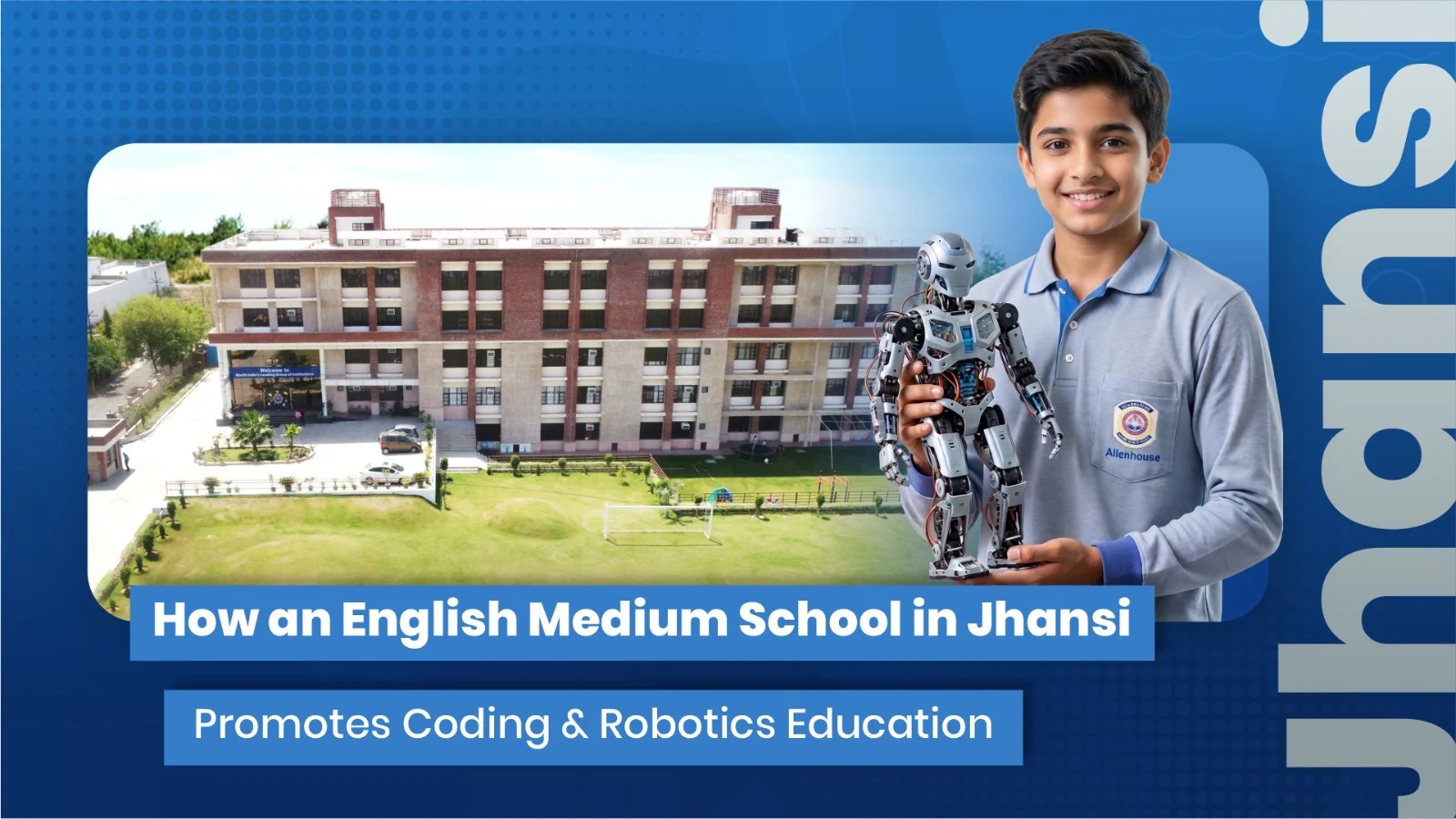
Coding and robotics are no longer skills reserved for engineering students. They are foundational thinking tools that every child needs and the English medium school in Jhansi building them seriously is Allenhouse. This blog covers how, and why it matters more than most parents in Jhansi currently realise.
Introduction
Here is something worth thinking about before we get into anything else. The average child in India today will spend forty-plus years in a workforce that does not yet fully exist. The jobs that will define the 2030s and 2040s are being shaped right now by artificial intelligence, automation, and the collision of creativity and computation in ways that are genuinely new. The question is whether their school is preparing them for it or hoping they figure it out later. Most schools are still hoping. Allenhouse Public School Jhansi is not. As the English medium school in Jhansi that has taken coding and robotics education most seriously, we have built programmes that nail it.
We prepare children for a technological future without reducing education to technical training. Thinking skills, creative problem-solving, and the ability to build things that work are what coding and robotics programmes at Allenhouse develop the best. This blog explains specifically how.
Why Coding and Robotics Belong in an English Medium School in Jhansi
Before getting into what Allenhouse Jhansi offers, let us address the question some parents still have: My child does not want to be a software engineer. Why does coding matter?
It is a fair question. And the honest answer is this. Coding is not primarily about producing programmers. It is about developing a way of thinking. A child who learns to code learns to break a complex problem into smaller, manageable steps. They learn to think in sequences: if this, then that. They learn to
test their thinking against reality
identify where it fails
improve it
develop precision
Stanford University research has consistently shown that computational thinking (the cognitive skill set that coding develops) improves analytical performance across academic subjects, not just in technology-related ones. Mathematics, science, logic-based reasoning are all benefits from the kind of structured thinking that coding builds.
Robotics takes this further. It adds the physical dimension. It brings the experience of designing something, building it, watching it fail, diagnosing why, and trying again. That process is one of the most powerful learning loops available in education. And it produces something that classroom instruction rarely does: genuine resilience. It teaches that failure is not the end of the attempt but the beginning of understanding.
6 Ways Allenhouse Jhansi Promotes Coding and Robotics Education
Without further ado, let’s get straight into why an English medium school in Jhansi like Allenhouse focuses on
1. Coding as a Core Skill
The first and most important distinction between schools that genuinely develop coding capability and schools that offer it as a periodic enrichment activity is where coding sits in the school's priorities.
At Allenhouse Jhansi, coding is treated as a foundational skill. It is introduced progressively across school years and built upon consistently, the way mathematics or language is built upon. Children are not introduced to coding once and left to forget it before it becomes useful. They return to it, develop it, and apply it across contexts in ways that build genuine fluency over time.
This progressive approach matters because fluency in anything requires consistent, repeated, building engagement across years. A child who encounters coding briefly in Class V and then not again until Class IX has not developed a skill. They have had an experience.
Students write real code that produces real outcomes (games, tools, simple applications), giving the learning immediate purpose
Programming concepts are assessed through application and output, not through theory-based recall
2. A Robotics Programme That Makes Engineering Tangible
Robotics at a top school in Jhansi does something that no amount of theoretical science education can replicate. It makes engineering real. Children build things with their hands, write the instructions that control those things, and then stand back and watch whether their thinking was correct.
Usually, the first time, it is not. And that moment is where the deepest learning happens. Because the child then has to think. Not remember something from a lesson. Actually think. What did I tell it to do? Why did it do something different? Where is the gap between my intention and my instruction?
That process of building, testing, diagnosing, and improving is what professional engineers do every day. Children who have practised it repeatedly in school arrive at technical higher education and careers with an advantage that is immediately visible to anyone teaching or hiring them.
Robotics work naturally integrates physics, mathematics, and programming — connecting subjects that textbooks typically keep separate
Competitions and project showcases create real stakes, giving students genuine motivation to push their skills further
3. STEAM Integration
One of the most common mistakes in technology education is treating it as purely technical. Coding and robotics taught without creative context produce technically competent children who struggle to identify interesting problems worth solving.
Allenhouse Jhansi deliberately integrates the Arts dimension of STEAM. Design thinking, creative problem-framing, and the ability to communicate ideas visually and narratively are taught alongside technical skills. This integration also opens coding and robotics to a wider range of students. A child who is creatively oriented (who loves storytelling, visual design, or music) may not immediately identify with coding. But when they discover that code is what makes a game's story unfold, or drives an animation, their relationship with technology changes entirely.
Animation, interactive design, and game development sit alongside traditional technical application in the programme
Design thinking is embedded into project briefs — students frame the problem before they write a line of code
Every student finds an entry point that connects to something they already care about, not just the ones who already consider themselves technical
4. Teachers Who Are Trained for This
Technology education delivered by a teacher who is not genuinely confident with the material produces anxious students and shallow learning. This is simply the reality of asking someone to teach outside their depth.
Allenhouse Jhansi invests specifically in faculty development for codingand robotics. Teachers who deliver these programmes are trained in both the technical content and the pedagogical approach which here means facilitating discovery rather than delivering instruction. The teacher's role is different from a traditional classroom. They are guides through a problem-solving process, not providers of correct answers. Knowing when to help, when to let a student struggle productively, and when to ask a question rather than give an answer is a specific skill. Allenhouse Jhansi builds it in its faculty deliberately.
Teacher development in this area is continuous, reflecting how quickly the field itself evolves
Faculty enthusiasm for the subject is treated as a hiring and development priority, because it is one of the most reliably contagious things in education
5. Infrastructure That Actually Supports What It Promises
Good coding and robotics education needs specific physical conditions. Computer labs with appropriate hardware and current software. Robotics kits and components maintained and available in sufficient quantities for meaningful individual engagement. As the best CBSE school in Jhansi for technology education, Allenhouse has invested in this infrastructure seriously. The facilities are working spaces used every day by students who are building things, writing code, making mistakes, and trying again, not preserved for open days.
Robotics workspace is designed specifically for the physical demands of the programme
Smart classrooms support technology-integrated instruction across subjects, not just within dedicated coding sessions
Hardware and software are updated regularly, not installed once and left to age
6. Connecting Coding and Robotics to Real Futures
The most powerful thing a school can do for any subject is make its relevance to a student's actual future visible. A child who understands not just what they are learning but why it matters engages with that learning in a fundamentally different way.
Allenhouse Jhansi connects coding and robotics to the real world deliberately. Guest sessions, project briefs based on genuine challenges, and exposure to career pathways in technology, engineering, design, and digital media make the learning feel purposeful in a way that abstract instruction never does.
Career pathways explicitly connected include software development, artificial intelligence, robotics engineering, game design, and digital media
Project briefs are drawn from real-world problems so that students are solving something, not completing an exercise
Students graduate with a portfolio of actual work that demonstrates capability to universities and future employers
What Coding and Robotics Actually Build: A Summary
Conclusion
Coding and robotics education done well does not produce children who stare at screens. It produces children who think clearly, build confidently, fail productively, and create things that did not exist before they imagined them.
Allenhouse Public School Jhansi is doing this well. As the English medium school in Jhansi that has taken technology education most seriously, we opt for STEAM integration preparing students for a genuinely future-oriented curriculum.
The children sitting in its robotics lab right now, debugging a programme that is not quite working yet, learning to think more clearly than most adults around them are the evidence.
Visit Allenhouse Jhansi. See the labs in action and watch what happens when a child figures out why their robot finally works.
Your Queries Answered
1. Why do English medium schools in Jhansi teach coding and robotics today?
Schools teach coding and robotics because technology is now part of almost every career and industry. These subjects help children improve logical thinking, creativity, problem-solving, and confidence with technology from an early age.
2. Does my child need to want an engineering career to learn coding?
No. Coding and robotics are useful for all students, not just future engineers. They help children develop thinking and problem-solving skills that are valuable in fields like business, design, medicine, media, and more.
3. What makes Allenhouse Jhansi strong for coding and robotics education?
Allenhouse Jhansi serves as the best CBSE school in Jhansi by offering coding and robotics as part of its learning approach through structured programmes, trained teachers, practical activities, and STEAM-based learning. Students learn by building projects and applying concepts in real situations.
4. At what age should children start learning coding and robotics?
Children can start learning basic coding concepts in primary school through games, activities, and visual tools. As they grow older, they gradually move towards more advanced coding and robotics projects.
5. How do coding and robotics help in competitive exams and future careers?
Coding improves logical reasoning and analytical thinking, which helps students in exams like JEE and other competitive tests. It also builds useful skills for future careers in technology, engineering, design, AI, and many other fields.