How a Leading CBSE Affiliated School in Jhansi Implements Social-Emotional Learning (SEL)
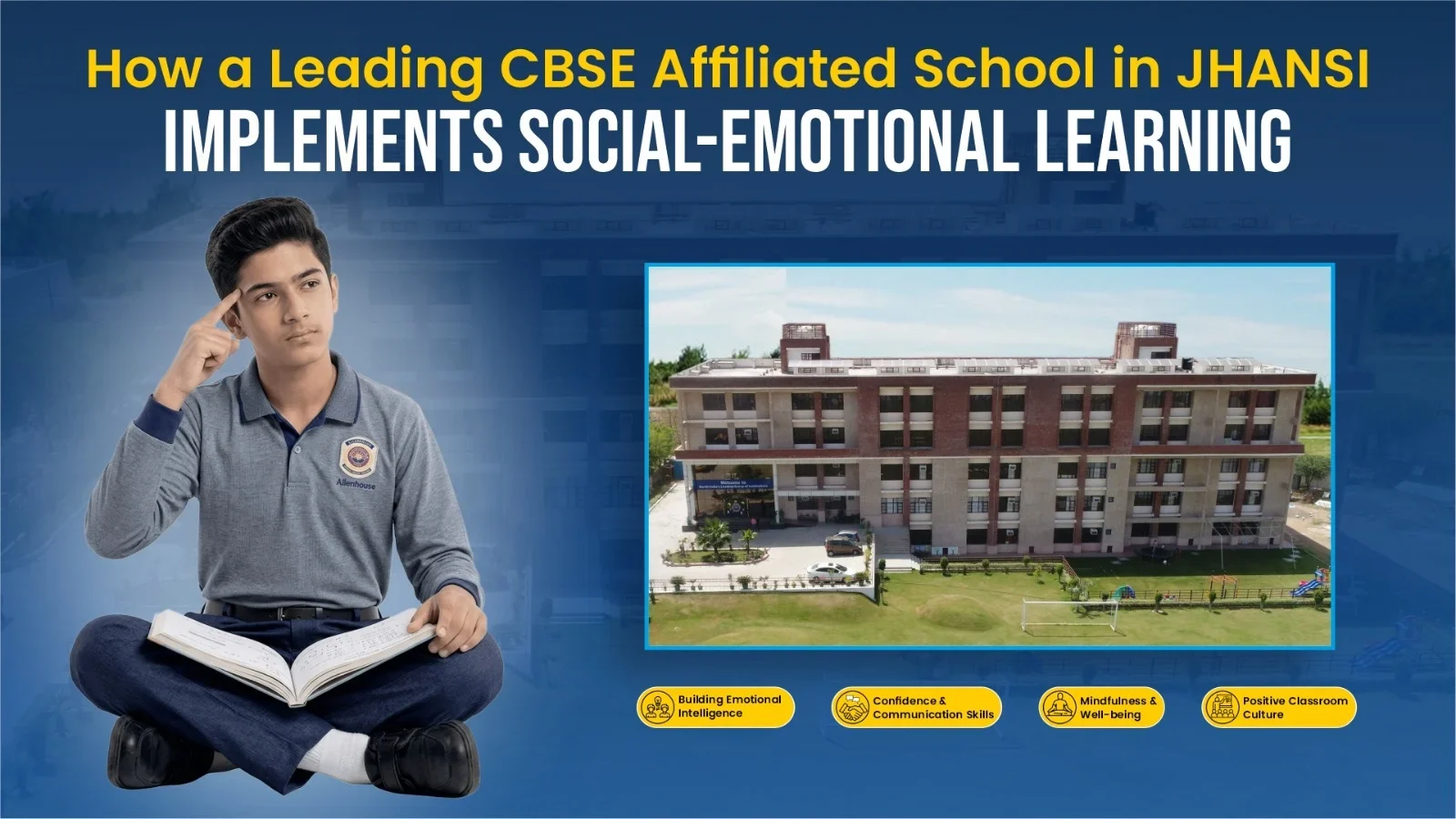
Academic results tell one part of a child's story. The other part is how they handle pressure, relate to people and deal with difficulty. This is shaped by Social-Emotional Learning (SEL)- something schools often don't talk about openly. This blog covers how Allenhouse, as a leading CBSE affiliated school in Jhansi, builds SEL into the fabric of how children are educated.
Introduction
There's a child every teacher remembers. He is not the one who scored the highest. Not the one who won every competition. The one who, when something went wrong (a bad result, a falling out with a friend, a moment of public embarrassment) somehow held themselves together. Thought it through. Came back the next day ready to try again. That child wasn't lucky. They weren't just born that way. Something in their environment, be it at home, at school, or both, had built something in them that most children don't get enough of. That’s Social-Emotional Learning. And it might be the most important thing a school can teach that never appears on a report card.
The leading CBSE affiliated school in Jhansi isn't waiting for parents to ask about it. At Allenhouse, we have built SEL as a fundamental part of what it means to be educated at all. This blog explains what that looks like and why it changes everything.
6 Ways How Social-Emotional Learning in CBSE Schools is Integrated
Now that you have an idea of how important SEL is, let’s get into how top schools in Jhansi are integrating it:
1. By Making Emotional Awareness Part of Everyday School Life
Most children go through school without anyone ever asking them a serious question about how they're actually doing. Not as a formality but as a genuine inquiry. The assumption is that if the marks are fine, everything is fine. And that assumption misses a lot.
Social-emotional learning in CBSE schools starts with something deceptively simple: creating an environment where children feel safe enough to be honest about what they're experiencing. They are not performing ‘okayness’. They are actually developing the vocabulary and the self-awareness to understand their own emotional states and what to do with them.
Allenhouse Public School, Jhansi, builds this from the ground up. There are morning check-ins, reflective journaling and structured conversations in classroom settings. These aren't explicit therapy sessions but silently serve as one. They're the quiet daily practice of emotional awareness that builds, over years, into genuine emotional intelligence.
Children develop the vocabulary to identify and name what they're feeling. It sounds small, but it matters enormously.
Structured reflection builds self-awareness as a habit
Teachers are trained to notice emotional states and respond to them, not just academic performance
A school culture that normalises emotional honesty reduces the isolation that academic pressure can create
Being a leading CBSE affiliated school in Jhansi we treat emotional awareness as a developmental priority, not an afterthought.
2. By Teaching Children How to Handle Relationships
Here is something no subject on the timetable prepares children for. It is how to deal with situations that are happening in every school, every day. The question is whether children are being given any tools to sail through them or whether they're just expected to figure it out on their own.
An English medium school in Jhansi that takes SEL seriously teaches relationship skills explicitly. Not through lectures about being kind but through structured, practical experiences. They build the actual capacity to understand another person's perspective, communicate honestly and resolve conflict without it becoming something bigger.
Perspective-taking exercises build genuine empathy. It is the ability to understand how a situation feels for someone else
Conflict resolution skills are taught and practised in real classroom and playground contexts
Children learn the difference between assertiveness and aggression. It is a distinction most adults haven't fully worked out
Cooperative learning tasks create genuine interdependence, which is where relationship skills are actually tested
Allenhouse Public School Jhansi gives children frameworks for dealing with difficult social situations before those situations become crises
3. By Creating a School Culture Where Every Child Feels They Belong
This one is harder to measure than a test score. But it might be the single most powerful thing a school can do for a child's development. A child who feels they genuinely belong at their school learns differently from one who does not feel so. They take more intellectual risks. They ask for help when they need it. They invest in the community around them. They show up, not just physically, but mentally and emotionally.
The leading CBSE affiliated school in Jhansi builds this sense of belonging intentionally through-
Inclusive classroom practices where every child (regardless of background, learning style, or temperament) is valued
Diversity is treated as a resource. It is not a challenge to manage.
Peer mentorship programmes build cross-age relationships that expand a child's sense of community
Teachers at Allenhouse Public School Jhansi are consistent, warm and genuinely invested in individual students.
4. By Developing Responsible Decision-Making as a Skill
Often small but children make hundreds of decisions every day. And the patterns built in childhood, about how to weigh options, consider consequences and act with integrity, follow people into adult life in ways that are very hard to unpick later.
Social-emotional learning in CBSE schools treats decision-making as a skill that can be taught. In fact, it can be practised and improved. This obviously is never about telling children what to decide, but through building the frameworks and the habits of mind that lead to better decisions over time.
At APS, this shows up in how ethical dilemmas are discussed in class. It comes up in how student leadership is structured and how children are given genuine responsibility and held gently accountable for how they use it.
Children are introduced to ethical thinking through age-appropriate discussions and real scenarios
Student leadership roles create genuine responsibility and decisions that actually matter to the people around them
Consequences of choices are explored openly and without judgment, building the habit of thinking ahead
Children learn to consider how their decisions affect other people. This is a habit that defines character over time
An English medium school in Jhansi that builds decision-making skills produces graduates who act with integrity, not just intelligence.
5. By Supporting Mental Health Before It Becomes a Crisis
India is getting more honest about mental health. Slowly, but genuinely. And schools are beginning to understand that they have a role to play. It is not just in referring students to support when things get bad, but in building the conditions that make things less likely to get bad in the first place. Academic pressure in any competitive school environment is real. Exam anxiety is real. Social stress is real. The question is whether a school treats these as inconveniences to be managed or as genuine experiences that deserve a genuine response.
Allenhouse Public School, Jhansi, has built mental health support into its school culture. We have trained counselors, open-door policies and stress management tools. These aren't reactive measures. They're preventive ones, built into the architecture of how the school operates.
Trained school counsellors are accessible and actively involved in student wellbeing, not called in only during emergencies
Stress management techniques (breathing, mindfulness, structured reflection) are taught practically and early
Academic pressure is acknowledged honestly and managed with awareness of its emotional impact
Children are taught to recognise when they need support and how to ask for it.
6. By Training Teachers to Teach the Whole Child, Not Just the Subject
Here is something that often gets overlooked in conversations about SEL. The most important factor in whether it actually works isn't the programme. It's the people delivering it.
A teacher who is emotionally intelligent is one who notices the child who has gone quiet. She responds to a mistake with curiosity instead of criticism. She is the one who creates a classroom where it is genuinely safe to not know the answer yet. That teacher is doing SEL every single day without calling it anything at all.
Allenhouse Public School Jhansi invests in its teachers accordingly. Not just in subject knowledge and pedagogical training, but in the human skills that determine the quality of the relationship between a teacher and a child. Because that relationship, more than any programme or policy, is where SEL actually lives.
Teachers receive ongoing training in SEL principles and their classroom application
Emotional attunement is developed and supported. It is the ability to notice and respond to a child's emotional state .
Teacher-student relationships are built on consistent warmth, clear boundaries and genuine respect
Teachers model the very skills they're developing in students — self-awareness, empathy and calm under pressure
Conclusion
A child who leaves school knowing how to manage their emotions and build real relationships is ready for life in a way that grades alone cannot produce. Social-emotional learning isn't soft and neither secondary. It is one of the most rigorous and important things a school can invest in.
Allenhouse Public School, Jhansi, as the leading CBSE affiliated school in Jhansi, has made that investment deliberately and thoughtfully. The result is a school where children develop into people who are genuinely capable of handling whatever comes next. That's what education is supposed to do. And that's exactly what SEL, done well, makes possible!
Your Queries Answered
1. What does SEL look like in the classroom?
Social-Emotional Learning (SEL) helps children build self-awareness, emotional control, empathy and decision-making skills. It matters because these skills improve both personal development and academic performance.
2. What is the role of NEP 2020 in promoting SEL at different stages of education?
NEP 2020 promotes Social-Emotional Learning (SEL) by embedding it across all stages of schooling. In early years, it focuses on emotional awareness and social skills through play-based learning. In middle and secondary stages, it emphasises communication, empathy and well-being through holistic and experiential learning.
3. How does SEL affect a child's academic performance in a leading CBSE affiliated school in Jhansi?
SEL improves focus, reduces stress and helps students handle pressure better. This leads to stronger and more consistent academic performance.
4. What role do teachers play in social-emotional learning at Allenhouse Public School Jhansi?
Teachers guide students by creating a supportive environment, showing empathy and helping them manage emotions. Strong teacher-student relationships are key to effective SEL.
5. How does SEL prepare children for life beyond school?
SEL builds skills like emotional control, communication and resilience. These help children manage challenges, build relationships and succeed in life and careers.