Top Benefits of Learning Robotics from an Early Age at a Leading School in Jhansi
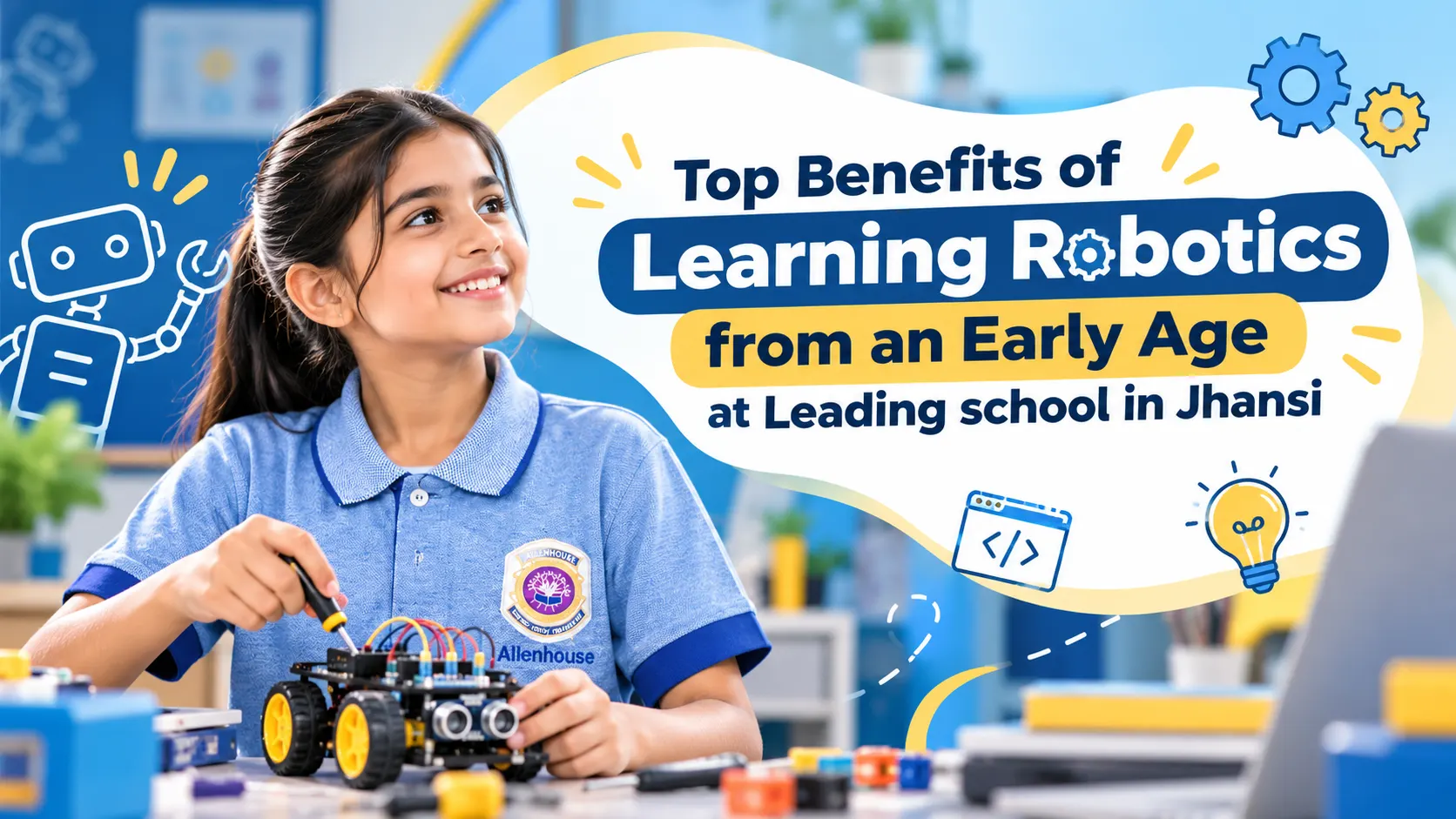
Robotics gives children a practical way to learn via building, testing and re-building. They make mistakes and try again. Along the way, they use Maths, Science, coding and creativity. Research suggests that educational robotics can benefit STEM learning in primary education. For parents, the bigger benefit is simple. Children learn how to think through a problem.
Introduction
Your child already interacts with technology every day. They use phones, computers, smart devices and digital platforms. But using technology and understanding how it works are two different things. Robotics gives children a chance to move from one side to the other. With it, they build something. They programme it. They test it. When it does not work, they look for the reason. That makes robotics useful well beyond engineering.
So, when you consider aleading CBSE affiliated school in Jhansi, do not look at robotics as only a technical subject. Look at what your child learns while building the robot.
Why Should Children Start Learning Robotics at an Early Age?
Children should start robotics when they can explore it at their own level. Early exposure lets them learn through simple building, instructions, movement and testing. They do not need advanced coding skills. They need opportunities to ask questions, try ideas and see what happens when they change something.
A 2024 systematic review and meta-analysis of educational robotics in primary education found its benefit for developing and strengthening STEM competencies. Furthermore, the World Economic Forum's Future of Jobs Report 2025 also found that analytical thinking is one of the most sought-after core skills among employers. All along technology literacy, creative thinking, flexibility and curiosity also continue to grow in importance.
What Early Robotics Learning Looks Like at a Leading CBSE Affiliated School in Jhansi
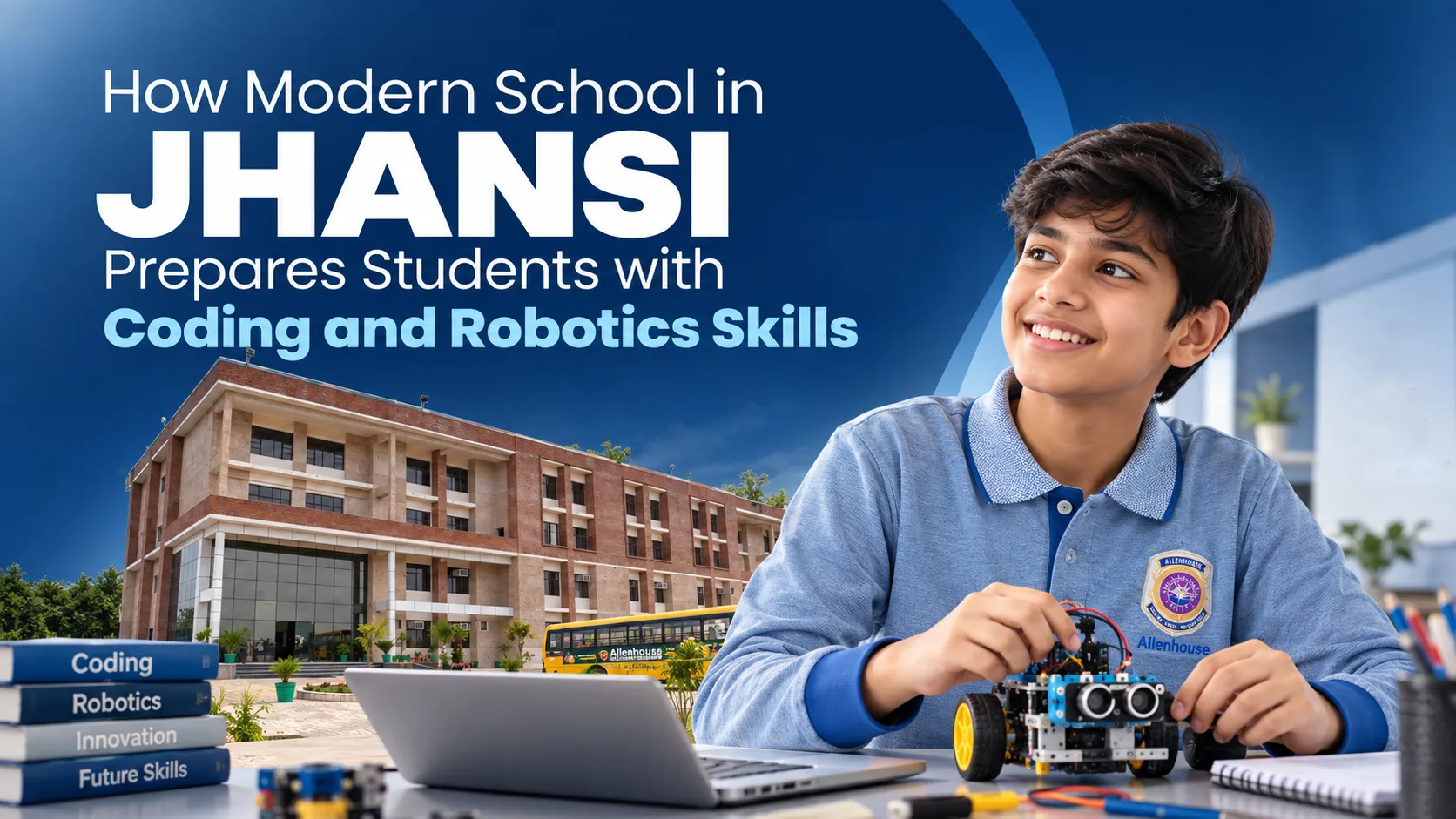
Imagine your child builds a small robot that should move forward and turn. It turns too early. Now your child has a problem to solve. They need to check the instructions, look at the design and figure out what changed. That is a real learning task. There is no need to explain the value of problem-solving in theory. The child is already doing it. Early robotics also gives children a practical introduction to STEM.
The level should match the child's age. A younger child can work with simple building activities, sequencing and movement. Older students can move into sensors, programming, automation and more complex projects. You should look for activities that let your child-
Build and experiment- Children learn more when they handle the components themselves instead of watching a teacher complete the entire project.
Follow and change instructions- Simple sequences teach children that the order of instructions affects the final result.
Test ideas- Students can make a prediction, run the robot and compare what they expected with what actually happened.
Try again- A failed attempt gives children useful information. They can change one part and test it again.
Top Benefits of Robotics Education for School Students
Robotics can support several skills at once because children have to think, make decisions and act on their ideas. They solve problems, use logical instructions, work with others and learn from failed attempts. These benefits extend beyond robotics because the same skills help children across subjects and everyday situations.
Develops Problem-Solving Skills
Robotics gives children a problem they can see and work on. They identify what is not working, try a solution and test the result. If it fails, they have to change something and try again. That makes trial and error a normal part of learning.
For example, a robot may not move as expected. Your child has to work out why. Perhaps the instructions are wrong. Perhaps a component needs changing. Perhaps the design itself needs another look. This teaches children to approach problems step by step.
They identify the problem first- Before changing everything at once, students learn to look at what actually went wrong and where the problem may have started.
They test their ideas- Students do not have to guess whether a solution works. They can make the change, run the robot and see the result.
They make improvements- A working project can still be improved. Students can look for ways to make it faster and more accurate/efficient.
This habit of testing and improving is useful far beyond a robotics lab.
Builds Logical and Computational Thinking
Robotics teaches children to give clear instructions and understand what happens when they change one part of a system. With robotics, it becomes easier to understand sequencing, patterns, cause and effect and basic computational thinking. It allows children to see the results of their instructions. That makes children think carefully about order and detail. If they want the robot to move forward and then turn, the instructions have to come in the right sequence. If they change one instruction, the outcome may change too. Students can develop-
Sequencing skills- Children learn that some actions need to happen in a particular order for a task to work correctly
Pattern recognition- Repeated movements and instructions help students notice patterns and use them to solve new problems
Cause-and-effect thinking- Students can change one part of a project and observe what happens, helping them connect an action with its result
Structured thinking- Breaking a larger task into smaller instructions makes complex problems easier to manage
These skills support learning in Maths, Science, coding and many other areas.
Encourages Creativity and Innovation
Students can also design their own solutions, choose how a project should work and modify it when they have a better idea. This gives creativity a practical purpose because children have to make their ideas work in the real world.
Give two children the same robotics kit and they may build two very different projects. That is part of the appeal. One child may focus on how the robot looks. Another may care more about what it can do. Someone else may find a completely different way to solve the same challenge. Robotics gives children room to-
Design their own solutions- Students can decide how they want a project to look or function
Modify existing ideas- They can take a basic design and change it to make the robot perform another task altogether
Accept that the first idea may not be the best- Children learn that changing an idea does not mean it failed, in fact, it is proof that they are still working on it. And that is a practical way to teach innovation.
Strengthens STEM Learning
Robotics brings Science, Technology, Engineering and Mathematics together in one project. Children can use measurement and motion as well as force, logic and basic coding while building something that actually moves or responds. This makes some abstract ideas easier to understand because students can see them working in front of them. Plus, students can see how different subjects connect through-
Mathematics- Measuring distances, counting movements, comparing results and working with numbers can become part of a robotics task
Science- Concepts such as motion, force, energy and simple machines can become easier to discuss when students see them in a working model
Technology- Students learn how components, sensors or programmed instructions help a machine perform a task
Engineering- Children identify a problem, design a solution, build it, test it and make changes based on what they observe.
This is one reason robotics works well within a wider STEM programme.
Improves Teamwork and Collaboration
Robotics projects often become easier when students work together. One child may build the structure, another may handle the coding and another may test the robot. They have to explain their ideas, listen to others and agree on what to change before they can complete the project.
Working in a team also teaches children something they do not learn from working alone. Your idea may not always be the idea the group chooses. Students learn to discuss it. They learn to explain why they think a solution will work, listen when another student disagrees and make changes when the evidence points in another direction. Through group projects, students can learn to-
Divide responsibilities- Teams can decide who will handle building, coding, testing, documentation or presentation.
Communicate clearly- Students need to explain what they have done and what they think the team should try next.
Listen to other approaches- Another student may notice something they missed. Collaboration gives them access to those different ways of thinking.
Work towards one result- The final robot belongs to the whole team, so students learn to coordinate individual tasks around a shared goal.
These are useful skills in school and later at work.
Builds Confidence Through Hands-On Learning
Children gain confidence the moment they see the result of their own work. Be it a finished robot or a solved challenge, it gives your child something concrete to point to. That experience can encourage them to take on another difficult task instead of avoiding it.
This matters for children who do not always shine in traditional classroom activities. A student may not enjoy answering questions from a textbook. Give them a robot that needs fixing and they may become completely absorbed in the problem. They learn by doing. They can-
Complete a project- Finishing something they built gives children a clear sense of achievement.
Fix a failed design- Students learn that a problem can have a solution if they keep working on it.
Present their work- Explaining how their robot works helps children speak about something they understand through experience.
Work more independently- As children become familiar with the tools, they can take greater responsibility for their projects.
Makes Learning More Interactive
Robotics changes what children do during a lesson. Instead of only listening and writing, they can build, predict, test and adjust. They get an immediate response to their decisions, which gives them a reason to keep investigating.
A child changes one instruction. The robot behaves differently. Now they have something to investigate. They can ask, "What changed?" That simple question can lead to a much deeper discussion. Robotics lets students-
Experiment- Children can make a prediction and then test it instead of simply being told the answer.
See results immediately- A robot's movement gives students direct feedback about their design or instructions.
Learn through action- Building, programming and testing give children practical experience with the concepts they are learning.
Stay involved- Students have a direct role in the outcome, so they have a reason to keep working when the first attempt fails.
What Should Parents Look for in a School's Robotics Programme?
Not every robotics programme offers the same experience. When you compare schools, look beyond the presence of a robotics lab. Check whether children actually build and test projects, whether the activities match their age and whether teachers guide them through problems instead of simply demonstrating the finished model. Here is what you should check.
Age-Appropriate Robotics Learning
A primary student should not receive the same robotics activities as a senior student. Good programmes increase the complexity as children become more comfortable with building, instructions, coding and problem-solving.
Look for-
Activities suited to the child's age- Younger students should work with simple concepts and gradually move towards more complex projects as their skills develop.
A clear progression- The programme should give children something new to learn at each stage instead of repeating the same activities every year.
Hands-On Projects
A robotics programme should give children time to build, test and experiment. If students spend most of the session watching someone else demonstrate a robot, they miss much of the learning that comes from doing the work themselves.
Look for-
Actual building and testing- Students should handle the components, assemble projects and see how their changes affect the outcome.
Room for experimentation- Children should be able to try their own ideas instead of following instructions so closely that every project ends up looking identical.
Qualified Guidance
Children need guidance when a project does not work. A good teacher or mentor in every leading CBSE affiliated school in Jhansi helps them find the problem without immediately fixing it for them.
Look for-
Teachers who ask questions- Instead of giving the answer straight away, mentors can guide students towards finding the solution themselves.
Support during difficult projects- Students should know where to turn when they are stuck, while still getting enough independence to solve the problem themselves.
Well-Equipped Robotics Labs
A robotics lab gives students access to tools and equipment they may not have at home. But the quality of the experience depends on whether those resources actually support meaningful projects.
Check whether the school provides-
Age-appropriate robotics kits and equipment- Students need tools that match their level and allow them to build projects rather than simply watch demonstrations.
Enough opportunities to use the equipment- A lab is useful only when students regularly work with the tools and have enough time to practise.
Integration with STEM and Other Subjects
Robotics works best when it connects with what students already learn. A project can reinforce Maths or Science while also introducing coding and design, making the activity part of the curriculum rather than an unrelated after-school exercise.
Look for-
Links with classroom subjects- Students should be able to use ideas from Maths, Science, coding and technology within their robotics projects.
Project-based learning- Projects should give students a reason to use what they have learnt and produce something they can test, explain or improve.
How Does Robotics Fit into a Leading CBSE Affiliated School in Jhansi?
Robotics adds to your child's education. It does not replace the subjects and activities already taking place. It can reinforce Maths and Science. It also provides a practical use for coding, supports creative work and gives students another way to practise problem-solving and teamwork. Your child does not need to choose between robotics and regular learning. The two can work together. A Mathematics lesson may help a student understand measurement. A Science lesson may explain movement or energy. A coding lesson may teach instructions and logic. Robotics can bring pieces of all three together in one project.
It can complement-
Classroom learning- Students get a practical way to use concepts they have already encountered in their regular lessons.
Mathematics and Science- Robotics gives abstract ideas a physical form, helping children see how numbers, measurements, movement and scientific principles affect a working project.
Coding and technology- Students can see the connection between a line of code and an action performed by a physical machine.
Creative activities- Designing a robot or deciding how it should solve a challenge gives children room to make choices and develop their own ideas.
Team projects- Students can work together on larger challenges, dividing tasks and bringing different strengths to the same project.
Problem-solving activities- Robotics gives children another setting in which to practise thinking through a problem and improving a solution.
That is why robotics works best as part of a wider school experience.
Conclusion
Robotics can give children much more than an introduction to machines. It teaches them to look at a problem, try something, see what happens and make another attempt. Along the way, they use Maths, Science, technology and creativity. They work with classmates. They explain their ideas. They learn that a failed attempt is not the end of a project. That is the real value of starting early.
You are not trying to turn your child into an engineer at age eight. You are giving them opportunities to explore technology while building skills that will help them in school and beyond.
If you are looking for a leading CBSE affiliated school in Jhansi, consider how robotics fits into the school's wider academic programme. Look at the lab, the projects, the teachers and the opportunities students get to build and experiment. The right environment at the best CBSE School in Jhansi can make robotics more than an interesting activity. It can become one more way for your child to learn how to think, create and solve problems. Visit Allenhouse for a quick tour!
Your Queries Answered
1.What is the best age for a child to start learning robotics?
There is no single age that works for every child. Many schools introduce simple robotics and building activities in the primary years and increase the complexity later. At a young age, the focus should stay on exploration, movement, instructions and simple problem-solving rather than advanced engineering.
2.Is robotics suitable for primary school students?
Yes. Primary students can learn robotics through simple, age-appropriate activities involving building, movement, sequencing and basic programming. They do not need advanced Maths or coding knowledge to begin. The important thing is to choose activities that match their age and let them learn by doing.
3.What skills do children learn through robotics?
Robotics can help children develop problem-solving, logical thinking, creativity, teamwork, communication and confidence. It also gives them practical experience with technology. These skills can support learning in other subjects and remain useful even if a child eventually chooses a career that has nothing to do with engineering.
4.Does learning robotics require prior coding knowledge?
No. Children can start with basic building and instructions before they move into more advanced programming. A good programme introduces coding at the right level and lets students understand what their instructions do through simple, visible results.
5.Which K-12 school in Jhansi offers robotics education?
Allenhouse Public School offers a robotics programme with a dedicated in-house academy. Check the school's current facilities and curriculum before making a decision. Ask specifically whether the school has a robotics lab, what age groups use it, how often students work on projects and who guides the sessions.